- 3.0M
- gaussians in the full forest scan
- 709 / 720
- views placed on the first real capture
- 15
- flat views cut from every 360 frame
- 7.5 → 50
- frames per second in TouchDesigner after tuning
ABOUT
OutSplat has three parts: an iPhone app, a training pipeline on cloud GPUs, and a web viewer. The app has guided capture modes for single objects, larger areas, and close-up detail, recording camera frames with ARKit poses and LiDAR depth. Footage from a 360 camera on a stick or a small drone goes through the same pipeline with no phone capture at all.
PIPELINE
Each 360 frame is picked for sharpness, then cut into 15 ordinary flat views, with the area under the camera masked so I don't end up in the scan. COLMAP recovers the camera path from those views alone, and placed all 1,200 views on a trail with no loop back. The levelled horizon sets which way is up and the height I carried the camera at gives real-world scale. Training runs on Modal, and every run is scored against views it never saw, so a change is judged by measurement and a side-by-side look.
OUTLIER WOODS
I walked the woods at the Outlier Inn with a 360 camera during an art and technology retreat, trained the footage with OutSplat, and brought the scan into TouchDesigner to play live. Root-like lines grow through the scanned trees and bend to the shape of the audio waveform. Letters from Wendell Berry's poem The Peace of Wild Things ride along the roots as they grow, so new growth writes the next words. A painterly pass repaints the whole scene in brushstrokes that follow the camera's motion.
IN TOUCHDESIGNER
The splats render through Lake Heckaman's GSOPs. Out of the box the scene ran at 7.5 frames per second in the editor; removing a duplicate draw and the extra render passes brought it to about 50 with every splat still on screen. The branching roots began from a tutorial by Dan Tapper. The painterly look is Shiva Viswanathan's Paintify, which only ran on Windows, so I ported it to macOS with Metal and Syphon and opened a pull request with the port.
ESSAY
I made a short video essay with the piece, asking whether 3D scanning is a gimmick or a medium, by way of Hito Steyerl, Roland Barthes, and a walk in the woods.
Live 3D scan
Real-time Gaussian splat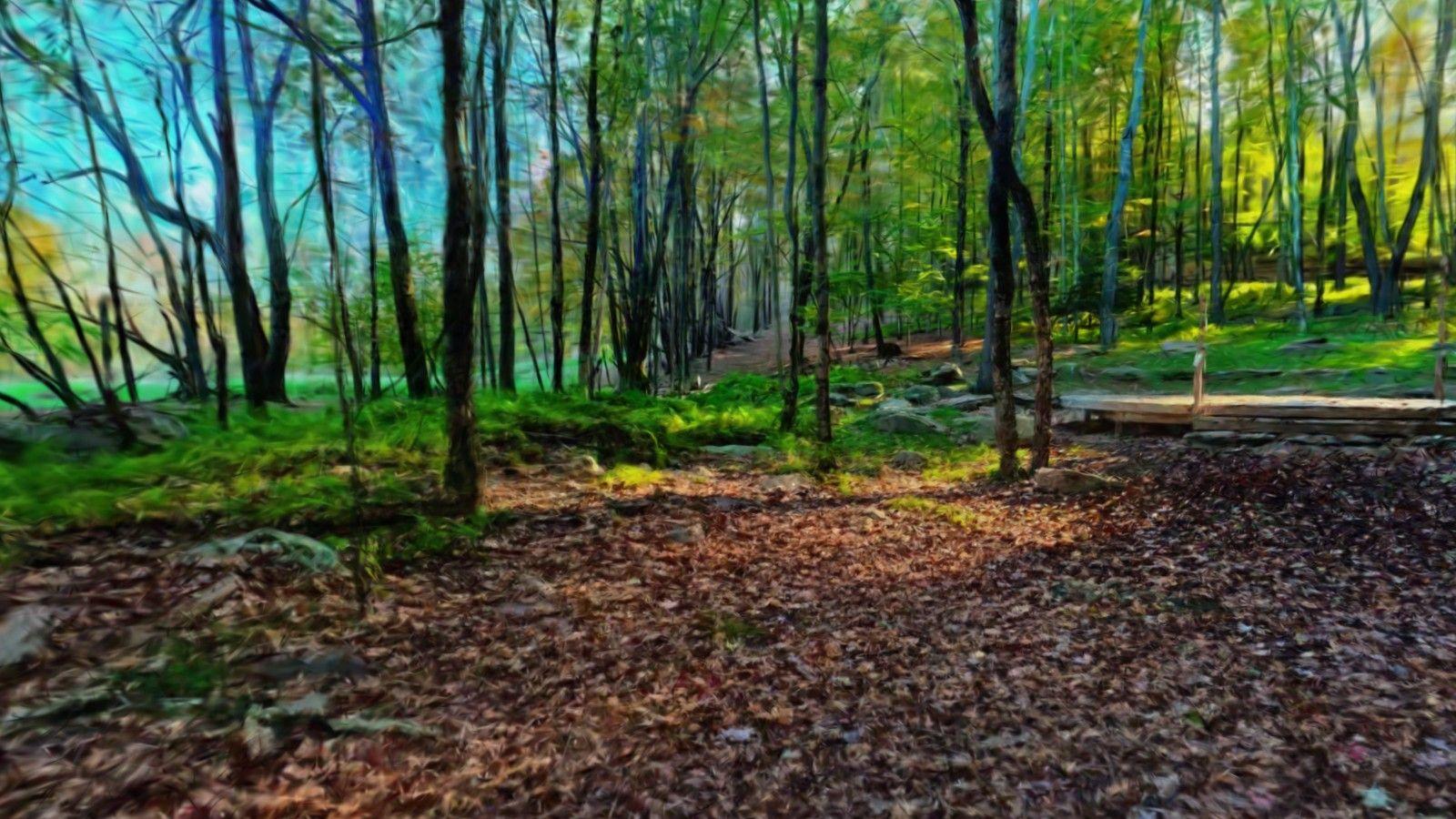
STILL
This is the scan itself, not a video. The woods at the Outlier Inn in upstate New York, captured on a three-minute walk with a 360 camera near sunset, then cut from 3 million gaussians to a size a browser can load.
